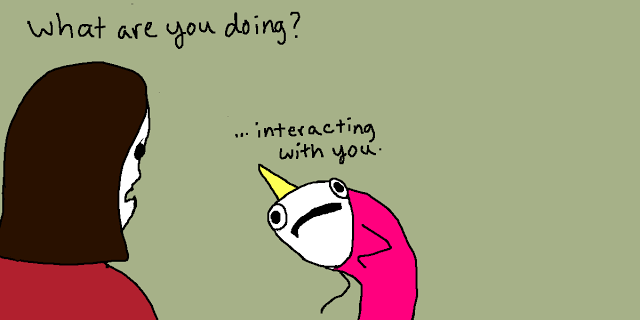
For once in my life, it would be wonderful if I didn't leave a doctor's office in tears.
Earlier this week, I went to see my new general practitioner about a particularly nasty sore throat.
I was worried it was strep not only because of the unbearably severe throat pain, but because I had both sweats and chills.
(As it turns out, I apparently just get night sweats.)
While I may not be able to decipher social cues as easily as most neurotypicals, after years and years of practice, I can tell when a medical professional is making assumptions about me--that I'm melodramatic, that I'm exaggerating my symptoms, that I'm too young to even be experiencing such symptoms.
Basically, they think I'm a liar and an addict because I request treatments that have been beneficial for me in the past.
When I told this particular doctor that being sick amplifies the pain I feel on a normal day, I asked her what I should do--and asked if I could take more of the Tramadol I'm prescribed (Tramadol is a opiod--a non-narcotic pain reliever that works on the same receptors that a opiate would, but is less addictive and, you guessed it, less effective). She said no, and to take the Naproxen I'm also prescribed (basically just a higher dose of Advil) along with a muscle relaxer at night.
Which I've been doing for three months, and it isn't doing jack shit to relieve the normal pain I experience, let alone the amplified pain from a cold.
So you know how when you have a fever, your bones sometimes feel like glass?
Try living that every single fucking day of your life, and having some asshat who got their MD from a box of Cracker Jacks that there is "nothing that [they] can do" about it (literally, LITERALLY, have been told this on SEVERAL occasions).
Part of the problem is, other than the entire medical industrial complex in general, my Autism.
Really, it's not MY problem--it's usually the doctor's. You see, because I have been dealing with severe pain for every day of my life pretty much ever since I can remember, I don't always look like I'm in pain. So when I tell a medical professional that my pain level is an 8, but my affect is completely flat (as has been noted several times in my medical charts), they don't believe me. They think they understand what pain looks like.
They know nothing.
It is my firm belief that no doctor should be allowed to treat chronic pain conditions unless they've experienced it themselves. I'm not suggesting that only chronic pain suffering doctors be allowed to practice--that would not be practical--but they had success with simulating labor pains (an experiment was done where husbands who doubted the degree of their wives' labor pains were hooked up to electrodes that simulated the pains of labor; needless to say, results were highly amusing), and there isn't any reason why Fibro pains couldn't also be simulated.
There have been so, so many times where I've wanted to ask a doctor who clearly doubts me how well they'd be able to perform their jobs or go about their lives with a pain level of at least 8 a day. (Hint: probably not very well.)
I think about all these zingers I could use on these doctors, but when I'm in that moment, I'm so focused on trying not to completely melt down in a crowded doctor's office that I can do very little but blink away the tears brimming on my eyelids.
I want to know when this will all end.
When it will finally come to the point where I'm not spending money I don't have on shitty people who generally do more harm to me than good.
This particular woman had the nerve to dismissively state, "I'm NOT giving you a narcotic. They don't work for fibromyalgia."
You know what, you ableist shitstain?
What I need is not a narcotic.
What I need is a change in circumstance.
What I need is:
* Time. Time to myself, time to decompress, time to rest and care for my body. In this culture, time is a luxury.
* Money. Money to support myself, to provide myself with nutrient dense foods, to be in control of my environment. In this culture, money is monopolized.
* Healthcare. Specialized care tailored to my unique needs, including but not limited to holistic care, massage, and acupuncture. In this culture, healthcare is a privilege.
* Revolution. Nearly all of our systems are broken: Justice, healthcare, economic, you name it. Most of the time, I am too tired for revolution. I am too sad, too heartbroken, too overwhelmed. Even if I am able to somehow attain all the aforementioned privileges, it will not be sufficient. We need to do better than we are doing now.
These are the things I need in order to be well, and all of them are beyond my grasp. Maybe not forever, but for now.
And until I have these things, I will continue to be in misery daily.
So get off your high fucking horse about the use of narcotics in pain relief*, and allow me to muddle through my existence with some dignity.
Viva la revoluction.
* I do want to make a point to say that I understand the potential dangers of narcotic use, particularly when used for chronic conditions. I believe other alternatives should be tried before they are used, and that their use should be monitored to ensure the health of the patient. I have been run through the gambit of SSRIs and other mood altering drugs, and it absolutely wreaked havoc on my Autistic brain. So many doctors are hesitant to prescribe opiates for fear of legal repercussions (bogus lawsuits involving folk who are prescribed opiates), and the drugs themselves are so heavily policed that you must pick the prescription up in person from the doctor's office (which can be hugely inconvenient for chronic pain sufferers who have mobility issues). But if a prescription for opiates is five dollars a month versus the costs of massage, yoga, or other homeopathic remedies, what choice does a low-income person have?
What started as an academic blog for Feminist Theory evolved into...this.
Friday, December 5, 2014
Monday, October 27, 2014
yeah so I might write a book (trigger warning)
So, this is a super rough draft of what is probably an introductory type chapter. A good friend recommended that I first write for myself, then decide later if I want to publish. There are a couple fairly recent books that deal with safety for Autistic women, but they're mostly guidebooks--this would be memoir.
HOKAY:
It has been my dream, ever since I can remember, to someday write a book. Growing up, books were my world. I really didn’t have friends, and I never quite fit in. Fantasy novels provided me an escape from my lonely reality, a sanctuary from a world I could never even begin to understand.
In my teen and early twenties, memoirs about depression very literally became my lifeline—the works of Elizabeth Wurtzel and Sylvia Path took root in me, validating my struggle, but not glamourizing it.
After my diagnosis, the works of Rudy Simone, Liane Holliday-Wiley and Debi Brown, provided for me a much needed framework to understand myself and my experience of the world, through the lens of Autism. I wouldn’t say it’s necessarily uncommon for a high functioning Aspie to be a good writer, but we certainly aren’t a majority. Writing is my gift, and I feel a strong calling to use it for the benefit of my people.
I won’t necessarily claim to speak for them—everyone experiences the world a little differently, Aspie or not—but high functioning females tend to share very similar profiles, and I believe we are particularly vulnerable to people who don’t have our best interests at heart.
For the longest time, I struggled to stick to a particular topic or memory to write about—my diagnosis, my childhood, or my journey post-diagnosis. These are all valid, book-length topics to write about, but they all stem from a singular incident, one that has haunted me since it came to pass. I avoided it for so long because it’s still so raw, so painful. It’s the reason I was diagnosed as Autistic, and it’s the reason why I have had to guard my heart and body so closely, for fear of violation. But the time has come, I think, for me to write about one of the worst things that ever happened to me, and one of the worst things I’ve ever done.
Just thinking about it is nauseating, and it’s triggering all sorts of traumatic feelings and memories.
Being this vulnerable is certainly a risk as an author—I haven’t decided if I want to publish it, or if I want to “out” myself as a victim of sexual manipulation in such a public way—but if I do, I know the audience will not be limited to Aspies or those who love and know Aspies. I know there is a chance my perpetrator will read it, or at the very least know of its existence, and the potential backlash I may experience is almost cause enough to do away with the project altogether. This backlash is not just limited to my own offender—I’m sure the trolls will line right up to slut shame me, to tell me I “asked for it,” that I’m using Autism as “an excuse,” that I’m to blame because I didn’t shout NO!, that I’m a terrible human being for dragging my abuser’s name through the mud (though I will be changing names to protect identities), that I “should have known better” and that I “need to take responsibility for my own actions.”
Obviously, this is not the demographic I am writing for—I’m writing primarily for other Aspergirls, so that they might avoid the mistakes that I made, or so that they might know that they are not alone in experiencing sexual manipulation—especially if, like me, they are uncomfortable with labeling their experience as “rape.” I’m also writing for my own healing; I’ve buried these thoughts and emotions for so long, to the detriment of my emotional and physical health, and I owe it to myself to get well again.
Deep breath.
It happened gradually, then suddenly. My initiation into sex was, in a lot of ways, incredibly unremarkable, given that in our culture, coercion and manipulation are heartbreakingly common sexual experiences. It happened with someone I implicitly trusted—someone I never dreamed would violate my trust in such a way. It was the summer after I graduated from college—a summer of uncertainty, confusion and fervor. I had come dangerously close to not graduating, and had no job, no money, and no prospects.
For the first time in my life, I was without structure; where my path had once been clear (get good grades in high school, go to college, get a good job), it was now rife with uncertainty and insurmountable debt. My friends were getting jobs, apartments, engaged, even having babies; I was staying up until 4 AM eating Hot Pockets in bed, watching 90s X Men cartoon reruns, pantsless. I was lonely and overwhelmed, and desperately craved connection and distraction.
Enter Cameron.
Cameron and I had been acquaintances for a few years—he was a friend of a friend who eventually dated said friend. Prior to our “relationship” (I use the term loosely, but there’s really no single word to describe what happened between us), I was convinced I was incapable of sexual feelings. Unlike most of the other girls my age, I had never dated a boy—never kissed a boy, been alone with a boy, or had even the slightest interest in pursuing a relationship of any kind with one. I knew on some level that it wasn’t “normal” for me to be this way—I had even considered the possibility that I might be gay, except for the fact that I really did not feel attraction to other people in the same way that everyone else seemed to.
If I’d had the knowledge of sexual identities that I do now, I would probably have identified as asexual. I did have crushes, but they weren’t really sexual in nature—it was more of a desire for emotional closeness, and the guys I liked tended to be a few years older than me, so they were much more mature than my male peers. With every single one of my crushes, I felt safe—a feeling I was altogether unaccustomed to, particularly around males.
Cameron was one of my crushes.
When he and I first met, I didn’t think much of him. He was hyper and high-strung, he dressed in high-end clothing, and he hung out with people who would never give me the time of day. For whatever reason, he persistently attempted to interact with me—it was his interest in me, more than anything, which sparked my attention. I was too shy to do anything about it—and really, I was not even remotely ready for a physical or emotional relationship. After a few months, the crush passed, and we didn’t interact much during my college career, save the occasional holiday get-together or Facebook post. Being alone didn’t bother me much—I’d seen so many people I knew involved in toxic relationships, defining themselves by their significant other, staying with a partner they hated just because they were afraid of being alone. I promised myself that that would never be me.
Thursday, October 23, 2014
The Struggle is Real
So, poverty is the worst.
The whole idea behind the living stipend and the disallowance of a second income is so that VISTA members “understand what it’s really like” to live in poverty. But the thing is, there are different levels of poverty—or I guess, more accurately, there are different levels or factors that go into one’s class status.
First, there’s the obvious—capital. Of which I am severely lacking.
Then there is your social network—so much of the job market is focused on your network, and 70% of recent college grads get their first job through somebody they know. When you have a social deficiency, such as Asperger’s, this pretty severely affects your job prospects.
Finally, there’s education—technically, I’m privileged in this area, because not only am I intelligent, I also have a degree from a prestigious college (even if it hasn’t gotten me anywhere). But along those lines, I also have a staggering amount of student debt, to the tune of $70,000. I’m having to pretty seriously consider declaring Chapter 7 bankruptcy.
The system is rigged and it’s totally unfair. The wealthy stay wealthy by circulating themselves and their progeny through expensive, exclusive private academies, and they’re always well-connected. If someone from the lower echelons, such as myself, tries to rise above their lower class background, they are inundated with debt, and that’s even WITH extensive financial aid. I come from an armed services, blue-collar, lower middle/working class family, and I grew up in a single-parent, female-headed household. Because I lacked the capital to move to a different city directly after graduation, and because I was not able to intern for free or for peanuts, I had no relevant work experience in an economically depressed town that’s rapidly becoming known as “Little Detroit.” I was living in relative poverty because of my loan payments, despite the fact that I lived at home and did not have to pay for housing. I also was not eligible for any kind of assistance, so I racked up credit card debt by buying luxuries such as groceries and health care services. I worked 50+ hours a week, sometimes seven days a week, at a high-stress, low-paying job that took gross advantage of my naiveté. I saw VISTA as my out from an oppressive, unhealthy environment. Had I been forced to say, I can say with a degree of certainty that I would probably have attempted suicide, or at the very least, seriously contemplated it. I didn’t need therapy—I needed out of an incredibly detrimental situation.
Unsurprisingly, VISTA was and is not a cure-all. In some ways—really, in a lot of ways—I’m actually worse off. I make $800 a month, and have $75,000 in debt. My rent is $550, my car is $150, and my phone is $40. These expenses are my first priority, which leaves me a paltry $60 for every other expense. I get $200 in food stamps a month, which means I eat a lot of cereal and over processed foods. I also have past medical bills, current and future medical bills (being sick and poor is the worst), two cats, and the absolute worst luck with automobiles.
But we wouldn’t want me to have a second income—because however will I understand what it is like to struggle?
Tuesday, September 16, 2014
In Transition
New job, new town, new friends, new life.
I'm about three weeks in, and it feels in equal turns stagnant and a whirlwind.
I suppose I've traveled enough to know that a change in geography does not make your struggles disappear, though I will say that any place you exist in will shape and change you in some way.
This new life should be the opportunity for me to develop into the person I'm becoming, but I see myself falling into old habits that have a tendency to pull me in a direction antithetical to growth.
Basically, I lay in bed all day and eat candy and cope very poorly with change.
Part of it are the forces beyond my control--my finances, which are constant threat to my physical and mental well-being; my Autism, which acts as a barrier to the outside world; and my fibromyalgia, that leaves me in constant physical pain and mental anguish.
The Sucky-Ass Trifecta.
At the risk of sounding like the platform of the Republican Party, I'm trying this new thing where I take more personal responsibility for my state of being.
True, I have been dealt several shitty hands in life. (Seriously, fibro is the fucking worst.)
But if I just lay back (or, as is more often the case, lie down) and let the pain consume me, I'm going to suck as a human being.
The pain will likely always be a part of my life, but I have to turn that around and make that life worth living, otherwise, what is the fucking point of even being alive?
I know what I have to do in order to be well again (or even if I could just get to the point where I didn't actively have fantasies about getting hit by a train to be put out of my agonizing misery), but it is, and always will be, an uphill battle.
And I am just too tired for that anymore.
I have to consider, though, that most of life is an uphill battle.
Is that stupid?
Absolutely. Because everything should be unicorns and rainbows.
But I think keeping the fact that struggle is just a part of life is an important perspective to have, because if we didn't have mountains, we would never learn how to climb them.
We would be clueless and dumb and we'd probably die in a flood at the foot of the mountain.
(Sometimes I get a little too in depth with metaphors--#aspergersproblems.)
I used to kind of bank on the idea that I was getting all of the shitty parts of life out of the way, and age 40 and on would be smooth sailing.
Perhaps it's not so much that it gets easier; perhaps we just develop better coping mechanisms, have more resources at our disposal, and have more life experience, patience and wisdom.
I am always, always, always thinking about transitions and liminal spaces.
It's breathtaking how things develop, grow, and change--particularly people.
So here I am, in my groovy, transitional state, wondering and dreaming about the person I'm going to be in twenty years.
Because she is going to be a total badass.
Wednesday, June 11, 2014
Fuq Da System
I really need to figure out a way to get paid for writing my hilarious and (sometimes) poignant thoughts, because this nine-to-five barely-making-ends-meet bullshit is really getting to me.
Basically, ten hours of my day are monopolized by work--I wake up at 6, and don't get home until four. Then, if I don't want to be in constant, horrible pain, I have to go to the gym, which usually takes about two hours with the commute, cardio, swim and shower.
So we're down to twelve hours. Eight of which should be dedicated to sleep, because I am a crankypants when not well rested. So, four.
BUT WAIT. Social obligations! Domestic chores! Errands! An extra half hour of cardio because I'm feeling oddly motivated!
FAAAAAAAAHHK
Basically, I have no time for myself, and that is a problem.
Now, obviously, this is a problem for a lot of people.
Probably most Americans.
But in my case, the case of an Autistic, the lack of time and space to decompress is detrimental to my health and well-being.
Tony Attwood, one of the leading experts in the field of Autism Spectrum Conditions, states that for every hour of social obligation, an Autistic needs an hour of alone or quiet time. Work is an obligation--a highly social one, at that. So basically, if I'm working eight hours, I need eight hours to chill the fuck out and calm down or my mental and emotional health will suffer.
Which it does, greatly.
I've been blogging for the past three years about how hopeless and stuck I feel, because I lack the resources (not to mention the energy) to get myself out.
People have said to me, "Just put yourself out there, something is sure to come along. You don't know if you don't try."
And it's not like they're wrong, necessarily--and generally, their advice is well-meaning.
But telling me to go out and just get a job is like handing me a water bottle and pencil and telling me to build a bird's nest.
I don't have the right tools, and I don't have a manual.
And it's not only my social difficulties--last year, I made just around $20,000. Poverty level.
My loans currently amount to about $80,000.
If I want to escape this crushing burden, I have to move to a place with better entry-level prospects.
In order to move, you have to have capital.
See the issue?
And even as economically oppressed and depressed as I feel, it doesn't even come close to what it must be living life without all the privileges I've been afforded--a mother who engaged me as I developed, who imbued me with a love for books and learning, who, at her own financial peril, co-signed several student loans, without which I would never have attended the institution I did.
There's this VISTA position I'd really love to take, but will probably be financially incapable of doing so because I can't catch a break with these goddamn loan servicers. I can't get an entry-level position in my field because entry-level positions require experience, usually in the form of unpaid labor or internships.
I am all for volunteerism, but the way unpaid labor is exploited in this country is sickening. As a high schooler, if I wanted to go out and do things with friends, or buy clothes, or do anything extra curricular, I had to pay for it myself. Obviously, my mom helped, and it's not like we were desperate for essential items, but what most middle class kids took for granted, I had to work for. I didn't have time to engage in unpaid labor or volunteer--I was busy trying to make it in the world, and I started work at the age of thirteen.
Even in college, I didn't do internships--something I sincerely regret, and something that's totally bitten me in the ass down the road. I didn't engage in unpaid (or low-paying) labor because I was trying to make ends meet in college. The extra expenses add up, even the non-frivolous ones, like health care and vehicle maintenance. Sure, there are paid internships, but most of those would have involved being not in Erie and living in a bigger city, with higher food costs.
Basically, I'm pissed that the system has set me up to fail. I'm pissed that despite all my hard work in education and the workforce basically means shit, because I'm stuck at a low paying job in an economically depressed town because I didn't have the privilege of being able to work for free--I needed money to survive.
And yet, I'm drowning. Still.
Tuesday, April 8, 2014
Spiders Are Scary, Autism is Not
[NOTE: Sometimes, Allie Brosh drawings encapsulate my emotional states better than any words in the English language. They are used profusely throughout this post.]
I spent a good deal of today feeling like this:
[Fig. A: 90% of my existence]
I feel like this on a fairly regular basis, because as an Autistic, I have to regulate and monitor my environment as best I can, because unwanted stimuli can emotionally incapacitate me for days. Literally, days.
[Fig. B: DAYS.]
Even so, I wouldn't change my neuro individuality. I'm kind of adorable, and way more funny than most people. So it's kind of upsetting when the topic of Autism is broached when I'm out to dinner with family members, and one of them remarks about how "scary" it is that they're estimating one in eight children is being diagnosed with some form of ASD.
First of all, that is YOUR fault for your continued insistence on procreating with us.
Y'all replicating our genes 'n shit.
Second, diagnosis is more prevalent because of increased awareness and education.
People are actually understanding that it's a thing, slowly but surely.
Third--"Scary?" Really?
Here is scary:
[Fig. C: Scary]
And you know? I originally Googled "scary spiders," but I was actually SO SCARED by the images yielded by that search, that I had to use this.
Other than spiders, do you know what's really scary?
The fact that someone that's known me and loved me since birth thinks I'm scary.
And I understand she's not literally afraid of me, she just doesn't understand Autism as a spectrum.
She's met a more severely affected Autistic, and made a snap judgement based on one interaction that he "cannot connect" because he didn't make eye contact and "looked right through" a person he just met.
It's scary that she can't see all the good a person with ASD possesses, because she can't see beyond what she perceives as disability.
Scariest, in my option, is that I feel unable to communicate this to her, because we don't speak the same language.
When strangers are ableist or uncommunicative or just don't get it, it's difficult, even disheartening.
But when it's someone who you love, and who loves you, it messes with your sense of identity.
[Fig. D: Existentialism]
When someone you love doesn't understand or can't acknowledge a part of you, it really messes with you emotionally, mentally, even physically--especially if, like most females on the spectrum, you have an autoimmune disorder or fibromyalgia.
It's scary, because if loved ones don't acknowledge who you are, how do you find your place in the world? I suppose you find your way eventually, and I'm sure I'll find mine one of these days (complete with epiphany and overture and montages, probably). But right now, it's incredibly lonely. And scary.
[Fig. E: Rly Tho]
I spent a good deal of today feeling like this:
I feel like this on a fairly regular basis, because as an Autistic, I have to regulate and monitor my environment as best I can, because unwanted stimuli can emotionally incapacitate me for days. Literally, days.
Even so, I wouldn't change my neuro individuality. I'm kind of adorable, and way more funny than most people. So it's kind of upsetting when the topic of Autism is broached when I'm out to dinner with family members, and one of them remarks about how "scary" it is that they're estimating one in eight children is being diagnosed with some form of ASD.
First of all, that is YOUR fault for your continued insistence on procreating with us.
Y'all replicating our genes 'n shit.
Second, diagnosis is more prevalent because of increased awareness and education.
People are actually understanding that it's a thing, slowly but surely.
Third--"Scary?" Really?
Here is scary:
And you know? I originally Googled "scary spiders," but I was actually SO SCARED by the images yielded by that search, that I had to use this.
Other than spiders, do you know what's really scary?
The fact that someone that's known me and loved me since birth thinks I'm scary.
And I understand she's not literally afraid of me, she just doesn't understand Autism as a spectrum.
She's met a more severely affected Autistic, and made a snap judgement based on one interaction that he "cannot connect" because he didn't make eye contact and "looked right through" a person he just met.
It's scary that she can't see all the good a person with ASD possesses, because she can't see beyond what she perceives as disability.
Scariest, in my option, is that I feel unable to communicate this to her, because we don't speak the same language.
When strangers are ableist or uncommunicative or just don't get it, it's difficult, even disheartening.
But when it's someone who you love, and who loves you, it messes with your sense of identity.
When someone you love doesn't understand or can't acknowledge a part of you, it really messes with you emotionally, mentally, even physically--especially if, like most females on the spectrum, you have an autoimmune disorder or fibromyalgia.
It's scary, because if loved ones don't acknowledge who you are, how do you find your place in the world? I suppose you find your way eventually, and I'm sure I'll find mine one of these days (complete with epiphany and overture and montages, probably). But right now, it's incredibly lonely. And scary.
Tuesday, December 10, 2013
For Brendon
When something like this happens, you think the world should stop.
That when something this senseless and terrible happens, that everyone should drop everything, that they should share in your grief, in your sadness.
If you can't go on, it means everyone else shouldn't, too.
Because someone you love is gone, a part of you is missing forever, and there is a hole in the world.
Nothing will ever be the same.
You're stagnant.
Yet, the world doesn't stop.
People go on, blind to your pain.
Ignorant of the suffering.
Unaware of the hole.
I was Googling "suicide statistics of chronic pain sufferers" when I overheard my mother mention funeral preparations.
I had come home early from work sick--the entirety of my lunch lost to the side effects of the drugs meant to lessen my physical pain.
Grandpa, I thought.
How would I approach this?
Grief doesn't confuse me, it's people--reactions are so different, and I am always unsure.
To touch, to keep a distance, to embrace, and for how long--these are hard questions to ask of the bereaved.
I stood in the doorway, waiting for her to turn around, to react.
Blankness.
This happens, sometimes. Shock. I think I understand, and I move to embrace her.
"Uncle Paul called. Brendan shot himself this morning. His mother found him."
Nothing in life can prepare you for these things, not even previous experience.
Not an uncle, not a father.
Each time it's different; each time, you're different.
He was seventeen, and this shouldn't have happened.
We grew up in separate states, and lived separate lives, but he was my blood.
When life is taken away before it begins, it makes you think.
Makes you put things into perspective.
Brendan, you probably didn't know I loved you.
You probably didn't know that I, too, struggle with life.
Maybe if you had, things would be different.
I'm sorry for your hurt.
I'm sorry you thought it would never end.
I'm sorry for everything you'll never be, but I loved you for everything you were.
I'll always remember the time you chased me around the house with Sock Em Bop Ems;
The time you got embarrassed for getting caught peeing in our back yard;
Always finding "Brandon" instead of "Brendon" on ornaments at Bronner's;
Your shenanigans and exploits as "Mr. Ass" at the Detroit Zoo.
I don't know how I'll face our family; your mom, you dad, your sister.
I don't know how I'll face seeing you again, one last time.
I don't know how I'll go on living, once the world starts up for me again.
I'd like to think I'll do something noble, like preventing this from ever happening again.
But I just don't know.
I'll miss you, Brendan.
And every time I see a "Brandon" ornament--I'll think of you.
Rest easy, cousin.
Subscribe to:
Posts (Atom)


.jpg)
.jpg)

.jpg)